



Hubble Space Telescope dimensions at a glance
The Hubble Space Telescope dimensions most often cited by NASA are 43.5 feet long, or 13.2 meters, and 14 feet wide at the observatory’s widest point, or about 4.2 to 4.3 meters. Those figures describe the main spacecraft body, not every deployed appendage. Hubble also carries a 94.5-inch, 2.4-meter primary mirror and two wing-like solar arrays, each commonly described in NASA and ESA materials as roughly 8 by 25 feet.
In practical terms, Hubble is about the size of a large school bus. Its dimensions, however, are more than a scale comparison. They reflect a shuttle-era observatory that had to fit inside the Space Shuttle payload bay, operate for decades in low-Earth orbit, and remain serviceable by astronauts during five servicing missions.
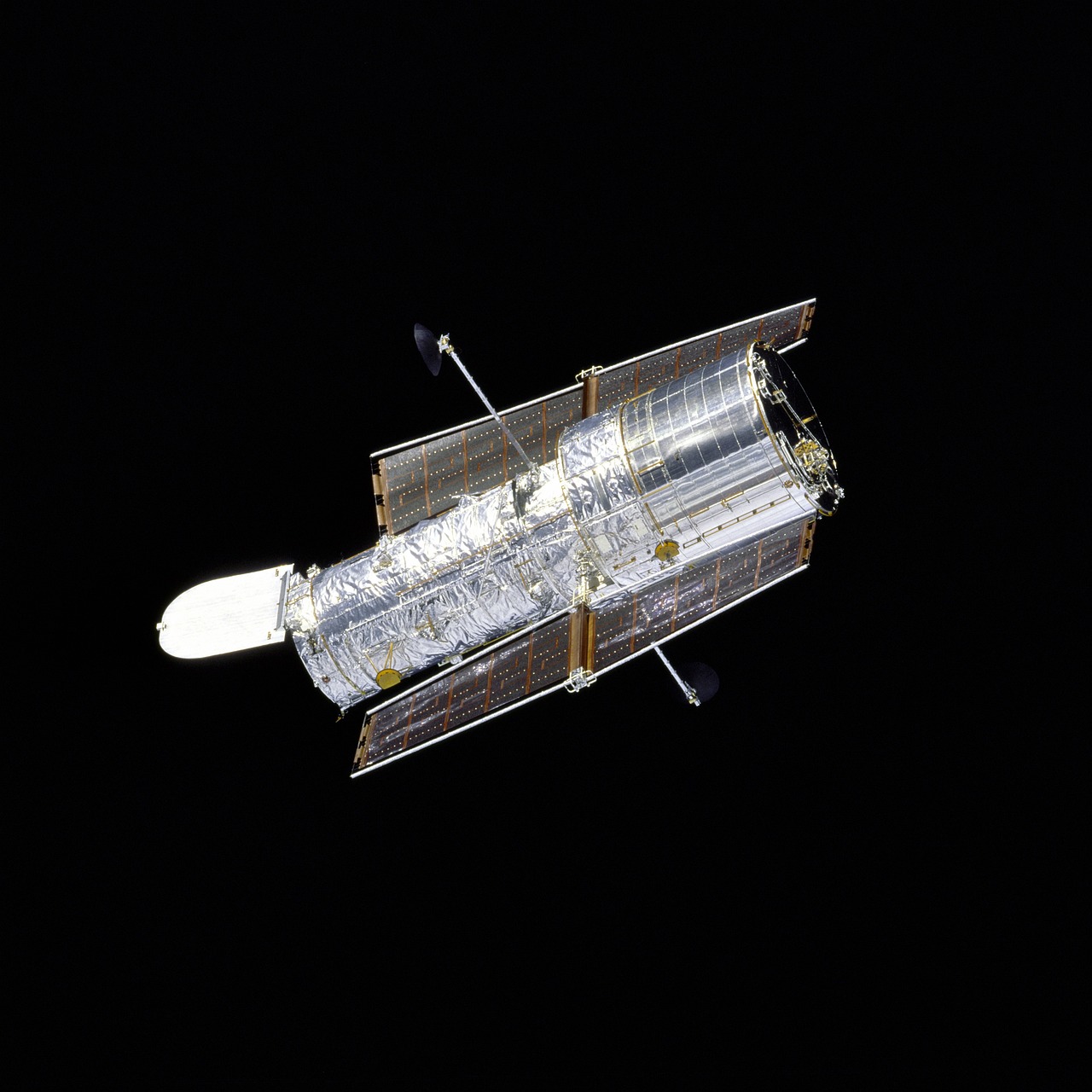
NASA’s mission pages and ESA’s Hubble fact sheet use slightly different rounding in feet and meters, but they point to the same basic conclusion: Hubble is a compact, serviceable orbital observatory built around a 2.4-meter mirror, which is relatively modest by today’s flagship telescope standards.
| Feature | Commonly cited measurement | What it means |
|---|---|---|
| Main body length | 43.5 feet, or 13.2 meters | The overall length of the spacecraft body, with some appendages discussed separately. |
| Widest diameter or width | About 14 feet, or 4.2 to 4.3 meters | The widest part of the observatory, near the aft section that houses science instruments. |
| Primary mirror diameter | 94.5 inches, or 2.4 meters | The light-collecting aperture that defines much of Hubble’s imaging capability. |
| Solar arrays | Two panels, each roughly 8 by 25 feet | The power-generating wings that make Hubble look wider in orbit than the body-only figure suggests. |
| Mass after the final servicing mission | About 27,000 pounds, or 12,200 kilograms | NASA’s post-Servicing Mission 4 figure, higher than Hubble’s launch mass because instruments and hardware changed over time. |
| Launch mass | About 24,500 pounds, or 11,110 kilograms | The mass listed in ESA and historical NASA materials for Hubble at launch. |
Why official Hubble size figures can look different
Small differences in Hubble dimension figures are common. One NASA page may round the telescope to 43 feet long and 14 feet wide, while another lists 43.5 feet long and 14 feet wide. Metric conversions may appear as 13 meters, 13.2 meters, 4.2 meters, or 4.3 meters. These are not separate versions of Hubble’s body. They usually reflect rounding choices, or whether a source is describing the cylindrical body, the widest aft section, a deployed component, or a simplified comparison.
The solar arrays add another layer of confusion. Hubble’s current arrays are not the original 1990 units. Astronauts replaced the arrays during servicing, including major solar-array work in 1993 and again during Servicing Mission 3B in March 2002. Older solar-array dimensions may therefore refer to earlier hardware, while newer NASA summaries describe the current gallium-arsenide array system in rounded terms. For a general answer, the safest wording is that Hubble’s body is 43.5 feet long and 14 feet wide, while its two deployed solar arrays extend the observatory’s operational footprint beyond the main body.
What counts as the size of Hubble?
The spacecraft body
The 43.5-foot length is the measurement most people mean when they ask about Hubble Space Telescope dimensions. It describes the main observatory, from the forward telescope structure to the rear instrument section. That body carries optics, cameras, spectrographs, pointing systems, communications hardware, electrical systems, thermal protection, and structural features that astronauts could work around during servicing missions.
The 14-foot width is usually described as the widest point at the back of the observatory. That rear section matters because Hubble is not simply a tube with a mirror. It is both spacecraft and laboratory, with instrument bays, electronics, doors, handrails, latches, and replaceable units. The width number is therefore an engineering envelope, not just the diameter of an optical barrel.
The mirror is smaller than the spacecraft
Hubble’s primary mirror is 2.4 meters across, or 94.5 inches. That aperture is large enough to gather faint light from distant cosmic objects, but it is much smaller than the 14-foot maximum spacecraft width. The difference is expected: a telescope mirror needs a support structure, a light path, baffles, thermal shielding, fine-guidance systems, science instruments, and a protective spacecraft around it.
This distinction is important because telescope size is sometimes compared only by outside dimensions. For science performance, mirror diameter is often the more meaningful number. For launch, servicing, power, and thermal control, the full spacecraft dimensions matter more.
The solar arrays change the visual footprint
Photos of Hubble in orbit often make it look wider than 14 feet because the solar arrays extend from the sides. NASA describes the arrays as the power source for Hubble’s instruments, computers, heaters, transmitters, and other systems. They are essential to operations, but they are not usually included in the simple body-length-and-width answer.
That is why two statements can both be accurate: Hubble’s main body is 14 feet wide at its widest point, and the observatory looks much wider when its arrays are deployed. The first statement refers to the spacecraft body. The second describes Hubble’s operating shape in space.
How the Space Shuttle shaped Hubble’s dimensions
Hubble’s size was not arbitrary. It was built for the Space Shuttle era. The Space Shuttle payload bay was about 60 feet long and 15 feet in diameter, and NASA notes that Hubble fit snugly inside Discovery for the STS-31 mission. Hubble launched on April 24, 1990, and was deployed into orbit on April 25, 1990. Its 43.5-foot length and roughly 14-foot widest diameter left enough room for launch accommodation while still allowing a large optical observatory to reach space.
The shuttle connection also explains why Hubble could be serviced. The observatory was designed with replaceable instruments and components, exterior handholds, access panels, and interfaces that astronauts could use while working from the shuttle’s robotic arm or payload bay. NASA carried out five astronaut servicing missions: December 1993, February 1997, December 1999, March 2002, and May 2009. Those missions corrected Hubble’s early optical problem, replaced aging hardware, upgraded instruments, and changed the observatory’s mass and capabilities without changing its basic body dimensions.
This serviceable architecture is a major reason Hubble has remained scientifically productive for decades. A smaller, sealed spacecraft might have been simpler to build, but it would not have offered the same upgrade path. A larger observatory might have exceeded the shuttle-era launch and servicing envelope. Hubble’s dimensions sit at the intersection of scientific ambition and the practical limits of its launch system. See also: AI.
What Hubble’s dimensions do and do not tell us about performance
Hubble is famous because it observes above most of Earth’s atmosphere, not because it is the largest telescope ever built. On the ground, atmospheric turbulence blurs incoming light unless advanced adaptive optics are used. From orbit, Hubble’s 2.4-meter mirror can deliver very sharp views across ultraviolet, visible, and near-infrared wavelengths.
Size still matters. A larger mirror can collect more light and, in principle, resolve finer detail. But Hubble’s performance also depends on mirror quality, instrument sensitivity, pointing stability, thermal control, detector technology, and calibration. Its long body provides the optical path and structural stability needed for precise observations. Its wide aft section houses instruments that have been upgraded over time. Its solar arrays and batteries support the electrical load. The dimensions are part of the system, not a complete measure of scientific value.
NASA’s 2024 move to operate Hubble in one-gyroscope mode is a useful reminder of this distinction. The change affected pointing operations and observing efficiency, not the physical dimensions of the observatory. Hubble’s size remains the same, while its operating methods continue to evolve as hardware ages.
How Hubble compares with the James Webb Space Telescope
A comparison with the James Webb Space Telescope helps put Hubble’s dimensions in perspective. Webb is much larger in its deployed science configuration, mainly because of its segmented 6.5-meter-class primary mirror and tennis-court-scale sunshield. Hubble, by contrast, has a 2.4-meter monolithic mirror and a compact shuttle-compatible body.
| Feature | Hubble Space Telescope | James Webb Space Telescope |
|---|---|---|
| Primary mirror | 2.4 meters | About 6.5 meters |
| Main design constraint | Fit in the Space Shuttle and be serviceable by astronauts | Fold for launch, then deploy a large mirror and sunshield in space |
| Primary observing strength | Ultraviolet, visible, and some near-infrared observations | Infrared observations of cool, distant, and dust-obscured objects |
| Operational location | Low-Earth orbit | Sun-Earth L2 region |
The comparison does not make Hubble obsolete. It shows how different mission goals drive different dimensions. Hubble needed to be reachable by astronauts and compact enough for the shuttle. Webb needed a much larger cold telescope and sunshield for infrared astronomy, so it was designed to unfold after launch. The two observatories are complementary rather than direct size-for-size replacements.
A short timeline of size-related Hubble milestones
- April 24, 1990: Hubble launched aboard Space Shuttle Discovery on STS-31, sized to fit inside the shuttle payload bay.
- April 25, 1990: Hubble was deployed into low-Earth orbit, unfolding from launch configuration into its operational form.
- December 1993: The first servicing mission installed corrective optics and replaced the original solar arrays, showing why Hubble’s serviceable design mattered.
- March 2002: Servicing Mission 3B replaced Hubble’s solar panels with more efficient arrays and installed the Advanced Camera for Surveys.
- May 2009: The final servicing mission added new instruments and hardware, after which NASA commonly lists Hubble’s mass at about 27,000 pounds.
- June 2024: NASA announced a one-gyroscope operating mode, a change in pointing operations rather than spacecraft dimensions.
For more mission explainers and astronomy coverage, visit the Roads News Space Science section.
Frequently asked questions
How big is the Hubble Space Telescope in simple terms?
Hubble is about 43.5 feet long and 14 feet wide at its widest point. NASA often compares it to the size of a large school bus, although that comparison refers to the main spacecraft body rather than every deployed component.
What is the diameter of Hubble’s mirror?
Hubble’s primary mirror is 94.5 inches across, or 2.4 meters. The mirror is much smaller than the overall spacecraft width because it sits inside a larger structure that includes supports, instruments, shielding, electronics, and spacecraft systems.
Do Hubble’s dimensions include the solar panels?
The commonly cited 43.5-foot-by-14-foot dimensions describe the main observatory body. The two solar arrays are usually described separately and make Hubble appear wider when fully deployed in orbit.
Why did Hubble have to fit inside the Space Shuttle?
Hubble was launched by Space Shuttle Discovery and was designed for astronaut servicing. Its dimensions had to work within the shuttle payload bay while leaving room for deployment and later repair missions.
Is Hubble bigger than the James Webb Space Telescope?
No. Webb is larger in its deployed observing configuration, mainly because of its much bigger segmented mirror and large sunshield. Hubble is more compact because it was built around a 2.4-meter mirror and a shuttle-serviceable spacecraft body.