


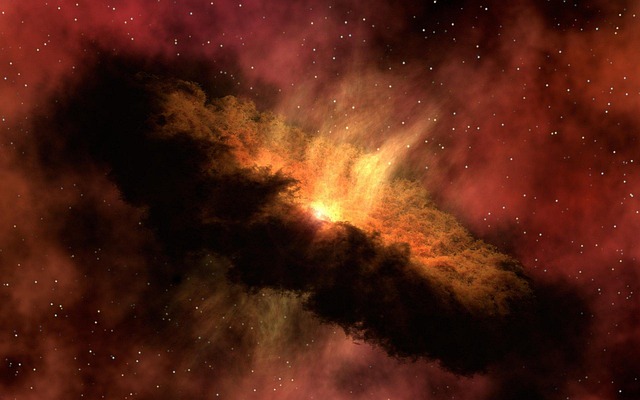

James Webb Space Telescope Finds an Early‑Universe Galaxy
The James Webb Space Telescope (JWST) has detected galaxies that formed within a few hundred million years after the Big Bang, reshaping current models of cosmic evolution. Its infrared instruments reveal structures previously invisible to Hubble, offering direct evidence that galaxy formation began earlier and faster than expected. These findings challenge theoretical limits on stellar mass growth and chemical enrichment, suggesting that the early universe was more complex and dynamic than standard cosmological models predict.
The James Webb Space Telescope and Its Role in Early‑Universe Observations
The JWST marks a major step forward in exploring the universe’s infancy. Its infrared capabilities allow scientists to peer through cosmic dust and detect light stretched by billions of years of expansion.
Advancements in Infrared Astronomy with JWST
JWST’s infrared sensitivity enables observation of galaxies formed shortly after the Big Bang. Unlike Hubble, which primarily observes visible and ultraviolet wavelengths, JWST detects faint, redshifted light from the earliest epochs. This longer wavelength range is essential for studying ancient galaxies whose light has been stretched by cosmic expansion. The telescope’s ability to capture photons from over 13 billion years ago allows astronomers to reconstruct the timeline of early star and galaxy formation.
Comparison Between JWST and Hubble Capabilities
Hubble transformed astronomy by imaging deep fields such as the Ultra Deep Field, yet its sensitivity declines beyond 1.6 microns. JWST extends this reach to nearly 28 microns, giving it access to objects far older and fainter. In practice, JWST can detect galaxies ten times dimmer than Hubble could see, revealing structures existing less than 400 million years after the Big Bang.
Importance of Longer Wavelengths for Probing Redshifted Light
Light from early galaxies is redshifted due to universal expansion. Observing at longer wavelengths is crucial for detecting this ancient radiation. JWST’s instruments are optimized for this task, translating redshifted signals into measurable data about stellar composition, temperature, and age.
Instrumentation Enabling Deep‑Field Discoveries
Behind every JWST discovery lies advanced instrumentation designed for extreme precision at faint flux levels.
NIRCam and NIRSpec as Primary Tools for High‑Redshift Galaxy Identification
NIRCam (Near Infrared Camera) captures wide-field images across multiple filters to identify potential high-redshift candidates. Once identified, NIRSpec (Near Infrared Spectrograph) performs spectral analysis to confirm their distances through emission line measurements such as Lyman-alpha breaks.
Spectroscopic Confirmation Methods for Early‑Universe Candidates
Spectroscopy allows astronomers to measure exact redshifts rather than relying on photometric estimates. By analyzing hydrogen emission lines displaced toward infrared wavelengths, researchers confirm whether a source truly belongs to the early universe or is a nearer interloper.
Calibration Challenges and Data Interpretation at Extreme Redshifts
At extreme redshifts beyond z=10, calibration becomes complex due to instrument sensitivity limits and contamination from foreground sources. Teams must carefully model detector noise, cosmic rays, and background subtraction to avoid false positives.
Redefining Early‑Universe Galaxy Formation Models
JWST’s first deep-field images have forced cosmologists to revisit long-standing assumptions about how quickly galaxies could form after recombination.
Observational Evidence from JWST’s Deep Fields
Galaxies detected at redshifts greater than 10 suggest that massive systems assembled within 300 million years of the Big Bang—far earlier than predicted by ΛCDM models. Their brightness implies rapid star formation rates inconsistent with gradual hierarchical buildup scenarios.
Luminosity Functions Suggesting More Massive Galaxies Than Predicted by ΛCDM Models
Observed luminosity functions show a higher density of bright galaxies than simulations forecast. If confirmed statistically, this means early star formation was more efficient or feedback processes were weaker than expected.
Reassessment of Star Formation Rates Within the First Few Hundred Million Years
Photometric data indicate intense bursts of star formation producing stellar masses exceeding 10⁹ solar masses soon after reionization began. Such efficiency challenges assumptions about cooling timescales in primordial halos.
Implications for Galaxy Assembly Theories
These results highlight tensions between theoretical frameworks and observational data.
The Tension Between Observed Stellar Masses and Theoretical Growth Limits
Simulations based on standard dark matter halos cannot easily produce such massive galaxies so soon after the Big Bang without invoking faster accretion or exotic physics like modified feedback efficiencies.
Possible Revisions to Hierarchical Structure Formation Models
If early galaxies grew faster through mergers or cold gas inflows than expected, hierarchical formation may need refinement to include stronger gravitational clustering or alternative initial conditions.
Influence of Dark Matter Distribution on Early Galactic Morphology
The spatial distribution of dark matter likely influenced how baryonic matter cooled into disks or spheroids. Variations in halo concentration could explain why some early galaxies appear surprisingly mature in morphology despite their youth.
Stellar Populations and Metallicity in the First Galaxies
Spectroscopic analysis reveals that many early systems already contain enriched elements—evidence that stellar evolution proceeded rapidly after the first stars ignited.
Characterizing Stellar Ages and Compositions
Spectral energy distributions show unexpectedly mature stellar populations with ages approaching several hundred million years even at high redshift. This implies that star formation began almost immediately after cosmic recombination ended.
Evidence for Rapid Chemical Enrichment Processes Soon After Reionization
Detection of oxygen and carbon lines indicates supernova-driven enrichment occurred quickly, dispersing metals throughout interstellar media earlier than previously modeled.
Constraints on Population III Star Contributions to Early Metallicity Levels
Population III stars—massive, metal-free progenitors—likely seeded these environments with heavy elements through short-lived supernova events before being replaced by Population II stars dominating subsequent generations.
Star Formation Efficiency in the Early Epochs
Star formation efficiency dictates how baryons convert into stars under varying environmental conditions during cosmic dawn.
Estimation of Baryonic Conversion Rates Based on JWST Photometry
By comparing stellar mass estimates with halo mass predictions, astronomers infer conversion efficiencies up to 20%, significantly higher than local averages observed today.
Environmental Factors Influencing Starburst Activity in Nascent Galaxies
Dense gas reservoirs combined with strong radiative feedback may have triggered intense starbursts lasting only tens of millions of years but producing large stellar populations quickly.
Comparison with Simulations Predicting Delayed Star Formation Onset
Most cosmological simulations predicted delayed onset due to inefficient cooling; however, JWST data imply earlier collapse driven by molecular hydrogen cooling or enhanced turbulence within primordial halos.
Reionization and Cosmic Evolution Insights from JWST Data
JWST’s deep fields not only reveal individual galaxies but also map how their radiation shaped large-scale ionized structures across space-time.
Mapping Ionized Regions Through High‑Redshift Observations
High-redshift observations link galaxy luminosity density directly with ionizing photon output required for reionization. Clustering patterns trace how ionized bubbles expanded around luminous sources during cosmic dawn.
Spatial Clustering as a Tracer for Reionization Topology
By measuring angular correlations among distant sources, researchers can infer whether reionization proceeded uniformly or patchily across different regions of space.
Synergy Between JWST Data and CMB Polarization Measurements for Epoch Timing
Combining JWST observations with CMB polarization constraints refines estimates for when reionization completed—likely between redshifts 6 and 8—narrowing uncertainties in cosmic timeline reconstruction efforts.
Revisiting the Timeline of Cosmic Dawn
Each new dataset shifts perspectives on when light first illuminated the cosmos.
Updated Constraints on When the First Luminous Structures Emerged
Current analyses suggest luminous structures appeared within 200 million years post-Big Bang—earlier than prior lower-limit estimates derived from Hubble observations alone.
Potential Shift in the Onset of Reionization Based on New Observational Limits
If confirmed populations exist beyond z=15, it implies ionizing photons were produced much sooner than conventional models predict, requiring reevaluation of photon escape fractions from young galaxies.
Integration of JWST Findings Into Cosmological Parameter Refinement Efforts
These discoveries inform refinements in parameters such as σ₈ (density fluctuation amplitude) and baryon fraction used in large-scale structure simulations aiming for consistency across epochs.
Theoretical Challenges and Future Prospects in Early‑Universe Studies
As data accumulates, theorists face growing pressure to reconcile unexpected findings with established frameworks while planning next-generation surveys for deeper insight.
Reconciling Observations with Cosmological Simulations
Discrepancies between observed galaxy mass functions and simulation outputs highlight missing physics in feedback or cooling prescriptions affecting early baryon collapse rates.
Adjustments to Feedback, Cooling, and Accretion Models to Match JWST Results
Revised models now explore stronger radiative cooling efficiencies or reduced supernova-driven outflows allowing faster gas retention during initial assembly phases.
Importance of Next‑Generation Simulations Incorporating Non‑Standard Physics Scenarios
Future simulations may incorporate non-standard dark matter candidates or variable initial mass functions to reproduce observed luminosities without violating physical constraints on baryon supply rates.
Anticipated Discoveries from Ongoing JWST Surveys
JWST continues scanning ultra-deep fields while collaborating across observatories worldwide to extend its reach beyond current detection thresholds.
Upcoming Programs Targeting Ultra‑Deep Fields Beyond Current Detection Limits
Planned surveys aim at cumulative exposure times exceeding one million seconds per field—potentially revealing galaxies at redshifts above 20 if they exist within observable volume limits.
Multi‑Wavelength Collaborations with ALMA, Euclid, and Roman Space Telescope Missions
Cross-mission synergy will combine millimeter-wave dust continuum data from ALMA with optical-infrared imaging from Euclid and Roman telescopes for comprehensive multi-wavelength mapping of early structures.
Prospects for Constraining Dark Matter Properties Through Early Structure Mapping
Mapping small-scale fluctuations traced by these primordial systems could constrain warm dark matter particle masses or self-interaction cross-sections through their influence on halo abundance patterns.
FAQ
Q1: How far back in time can the James Webb Space Telescope observe?
A: It can detect light emitted more than 13 billion years ago from galaxies formed just a few hundred million years after the Big Bang.
Q2: What makes JWST better suited than Hubble for early-universe studies?
A: Its infrared instruments capture longer wavelengths that penetrate dust clouds and detect highly redshifted light invisible to optical telescopes like Hubble.
Q3: Why are high-redshift galaxy discoveries significant?
A: They reveal that massive galaxies existed earlier than expected, forcing revisions in theories about how fast stars formed after cosmic dawn began.
Q4: How does JWST confirm distances to ancient galaxies?
A: Spectroscopic analysis measures emission line shifts caused by cosmic expansion, providing precise redshift values indicating each galaxy’s distance.
Q5: What future missions will complement JWST’s work?
A: Collaborations with ALMA, Euclid, and Roman Space Telescope missions will expand coverage across multiple wavelengths for integrated studies of early structure formation.