



The James Webb Space Telescope has become one of the main tools in modern astronomy because it can read cold, dusty, and very distant objects in infrared light. If you follow Space Science news, Webb is more than an image maker; it is helping researchers check ideas about galaxy growth, exoplanet chemistry, and star birth.
The points below come from public material from NASA Science, ESA, STScI, and peer-reviewed papers in Nature. Some Webb claims still need more spectra and repeat checks, so the fair answer is simple: Webb matters because it turns faint infrared light into data that can be measured and tested.
What Makes the James Webb Space Telescope Different?
Webb was built for work that older space telescopes could only cover in part. It looks at the universe mainly in infrared wavelengths, where old stretched light, cool dust, and planet atmospheres leave useful signs.
Infrared Vision for Hidden Light
NASA Science lists Webb’s wavelength coverage at about 0.6 to 28.5 microns, from visible red into mid-infrared light. That range matters because the universe expands and moves early galaxy light into infrared wavelengths. It also lets Webb look through dust that can block visible light. In plain terms, Webb can study places that look dim or hidden to many visible-light telescopes.
A Large Segmented Mirror
Webb’s primary mirror is about 6.5 meters across and is made of 18 hexagonal segments. NASA’s public FAQ says the mirror has about six times the collecting area of Hubble’s mirror. With more collecting area, Webb gathers more faint light, so it can pick up weak signals from very distant galaxies or from thin gas layers around a planet.
A Cold Orbit Far From Earth
Webb works near the Sun-Earth L2 region, roughly 1.5 million kilometers from Earth, according to NASA Science. Its large sunshield keeps the telescope cold, and that matters because heat from the telescope itself would make infrared signals harder to read. Key mission facts often used by NASA and ESA are:
- Launch date: December 25, 2021, on an Ariane 5 rocket from French Guiana.
- Main partners: NASA, ESA, and the Canadian Space Agency.
- Core instruments: NIRCam, NIRSpec, MIRI, and FGS-NIRISS.
Why Does Webb Matter for Early Galaxies?
Early galaxies are hard to study because their light is faint, old, and stretched by cosmic expansion. Webb gives astronomers clearer images and spectra, so distance estimates can move from “possible” to “measured.” That small move changes the science.
A Sharper Look at Cosmic Dawn
NASA’s first Webb science images, released in July 2022, showed SMACS 0723, a galaxy cluster with thousands of galaxies. NASA described that view as a patch of sky about the size of a grain of sand held at arm’s length. The line is easy to remember, but the point is practical: one small patch of sky can hold a long record of cosmic history when the telescope is sensitive enough.
Redshift Records With Spectra
A Nature paper published on July 29, 2024, reported spectroscopic confirmation of JADES-GS-z14-0 at redshift 14.32. NASA later noted on its Early Universe science page that MoM-z14 was confirmed in June 2025 at redshift 14.44, placing it about 280 million years after the big bang. These records may change as more data comes in, but the main point holds: Webb has pushed galaxy studies much closer to the start of cosmic history.
Bright Young Galaxies That Raise Questions
NASA’s July 2025 three-year science recap said Webb found bright galaxies within 300 million years of the big bang, along with early black holes that seem massive for their age. That finding does not, by itself, “break” cosmology. It does tell researchers to look harder at early star formation, gas cooling, dust, and black hole growth.
How Does Webb Study Exoplanet Atmospheres?
Webb does not need a close-up photo of an exoplanet to study its air. In many cases, it watches a planet pass in front of its star and measures small color changes in the starlight.
Starlight Filtered Through Alien Air
When a transiting planet crosses its star, a small amount of starlight passes through the planet’s atmosphere. Different gases absorb different colors. NASA describes this work as transmission spectroscopy. Webb is well suited to it because it can measure many infrared colors with strong precision. The result is a chemical fingerprint, not a travel-poster image.
WASP-39b as a Clear Case Study
NASA reported that Webb’s NIRSpec observed WASP-39b on July 10, 2022, and found clear evidence for carbon dioxide between 4.1 and 4.6 microns. A Nature paper published in 2023 presented the CO2 detection from JWST transmission spectroscopy. The reason WASP-39b works well is straightforward: it is a hot, puffy gas giant, so its atmosphere is easier to probe. The wider lesson is that Webb can test planet formation chemistry outside the solar system.
Rocky Worlds Remain Difficult
You may see strong headlines about habitable planets, but small rocky worlds are much harder to read. Their atmospheres, if they have them, make much smaller signals. Webb can still help by checking targets such as TRAPPIST-1 planets. Even then, reliable answers need multiple observations and careful comparison. If a public dataset is too weak, the honest answer is “not confirmed yet.”
What Does Webb Show About Stars, Dust, and Nebulae?
Dust is not just loose material in space. It is part of star birth, planet building, and galaxy growth. Infrared light lets Webb study dust-rich regions where visible light is blocked or scattered.
Star Birth Behind Thick Clouds
In the July 2022 first image set, NASA highlighted the Carina Nebula’s NGC 3324 region, often called the Cosmic Cliffs. Webb showed areas of star formation that had been hidden in visible light. The setting is a young stellar nursery. The data show jets, cavities, and sharp cloud edges shaped by newborn stars. The lesson is that star birth is not smooth; it is uneven, active, and shaped by feedback.
Dust Chemistry in Real Places
MIRI, Webb’s mid-infrared instrument, is useful for warm dust and complex molecules. In galaxies and nebulae, infrared data can show where dust grains are heated, broken apart, or shielded. This matters because dust helps gas cool. Cooler gas can then collapse into new stars. A red glow in a Webb image often points to real chemistry, not only image coloring. See also: AI.
Familiar Images With New Physics
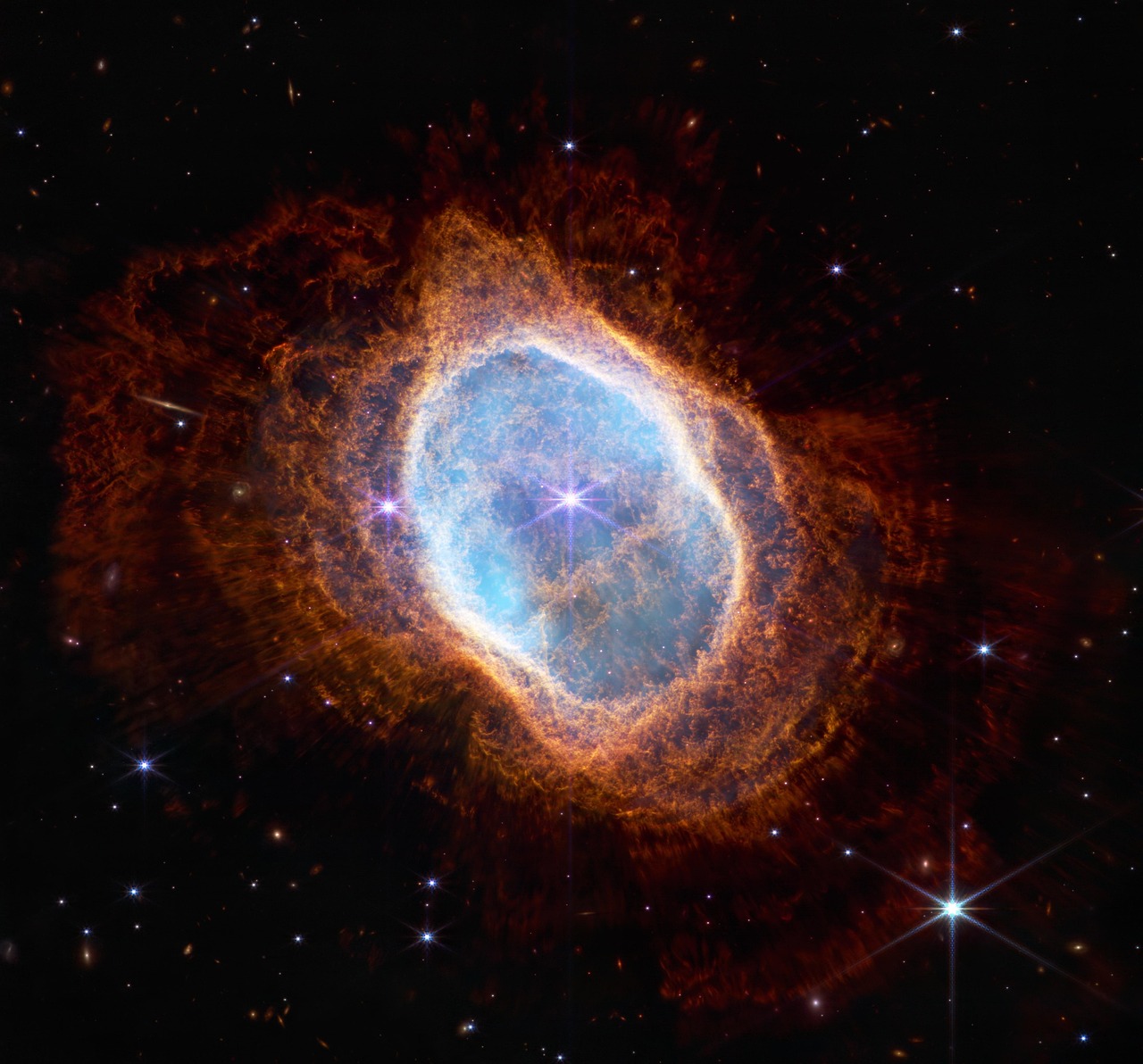
Webb often revisits known places, including the Southern Ring Nebula and Stephan’s Quintet. The value is not about nostalgia. NASA’s first image materials noted that Webb found hidden dust around the dimmer central star in the Southern Ring Nebula and traced gas interactions in Stephan’s Quintet. That means astronomers can get new physics from targets they already knew well.
Is Webb Better Than Hubble?
The easy headline says “Webb vs Hubble,” but the better answer is less dramatic. Webb and Hubble cover different wavelength ranges and answer different questions. Space science still needs both.
Different Wavelengths, Different Jobs
Hubble is known for ultraviolet, visible, and near-infrared work. Webb was built for near and mid-infrared science. That is why Webb is stronger for very old redshifted galaxies, cool dust, and many exoplanet molecules. Hubble remains useful for visible structure, ultraviolet activity, and long-term comparison. They are not doing the same job. They work more like different instruments in the same band.
Hubble Still Matters
Hubble has observed space since 1990, giving astronomers decades of baseline data. That long record helps researchers spot changes in planets, stars, supernovae, and galaxies. Webb adds infrared detail, but it does not make older data less useful. In real research, a Hubble image beside a Webb image can be more helpful than either one alone.
Webb Answers Colder Questions
Webb is the better tool when the question depends on cold material or stretched light. That includes dusty star-forming regions, ancient galaxies, brown dwarfs, and many molecules in planet atmospheres. If the target is early light or hidden warm dust, Webb is usually the right telescope for the job.
What Should You Watch Next From Webb?
Webb’s most useful results may not be the ones that trend for a day. The stronger value comes from repeated observations, open archives, peer review, and teams checking each other’s work.
Peer Review Before Big Claims
Early Webb galaxy candidates sometimes changed after better spectra became available. That is normal science, not failure. A photometric estimate can point to a faraway galaxy. A spectroscopic measurement can confirm its redshift. When you read a Webb headline, check the method, the instrument, the date, and whether the result has passed peer review.
Public Archives and Repeat Checks
STScI manages Webb science operations and public data access. Because of that, many observations can be checked again by other teams. This matters because Webb data are not simple files. Calibration choices, background light, and instrument modes can all affect a result. Repeat checks turn a good signal into stronger science.
A Mission With More Big Results Ahead
Webb was planned as a major observatory for the 2020s and beyond. NASA’s early mission updates noted that launch accuracy helped save fuel, which supported a longer operating outlook than the minimum requirement. Future work should bring deeper galaxy surveys, better exoplanet spectra, and closer views of star-forming regions. Space news may move fast, but Webb science often improves when teams take time to recheck the data.
FAQ
Q1: What Is the James Webb Space Telescope Used For? A: It is used to study early galaxies, star formation, exoplanet atmospheres, dust, black holes, and objects in the solar system, mainly through infrared light.
Q2: Why Is Webb So Good at Seeing Distant Galaxies? A: Ancient galaxy light is stretched into infrared wavelengths by cosmic expansion, and Webb was built to collect and analyze that infrared light with a large cold mirror.
Q3: Did Webb Replace Hubble? A: No. Webb and Hubble do different jobs. Webb is stronger in infrared science, while Hubble still provides useful ultraviolet, visible-light, and long-term data.
Q4: Can Webb Find Life on Exoplanets? A: Webb can study gases in some exoplanet atmospheres, but it has not confirmed life. Any life-related claim would need strong data, repeat observations, and careful review.
Q5: Are Webb Images Real Colors? A: Many Webb images use assigned colors because infrared light is outside normal human vision. The colors are based on real data, but they are translated so people can see patterns and structures.