



Why Does Astrophysics Space Science Matter Now?
Astrophysics space science is no longer a field built around waiting years for one unclear image and one careful paper. Space telescopes, gravitational-wave observatories, planet-hunting missions, and large sky surveys now add new evidence on a regular basis. For readers following Space Science, the main change is easy to see: the universe is now read through data, not only through what we see in the night sky.
The point is not to make you a professional astronomer in one sitting. It is to help you read space news with better judgment. When a report says a telescope has found an early galaxy, an unusual planet, or a black hole merger, you can ask the basic questions first. What instrument measured it? What data supports it? Does it challenge an old model, or does it add one more part to a problem that is still being worked through?
Space Data Has Become Much Richer
Modern astrophysics uses more than visible light. Researchers also work with infrared light, X-rays, radio waves, neutrinos, cosmic rays, and gravitational waves. NASA Science reported in 2026 that more than 6,200 exoplanets had been confirmed, with many more candidates still waiting for follow-up checks. That figure shows how far the field has moved from guessing about other worlds to sorting real planetary systems by size, orbit, density, and atmosphere. (science.nasa.gov)
Big Questions Now Have Testable Clues
Older astronomy had to ask large questions with limited tools. Today, researchers can test parts of those questions with measured data. How fast did early galaxies form? What happens when black holes collide? How common are rocky planets? What shapes galaxy clusters? None of these has a clean final answer yet, but each one now has clues that can be checked and compared. That is why the field keeps moving; one answer often leads to several new tests.
Public Missions Shape Everyday Space News
A large share of the evidence comes from publicly funded missions and research teams working across countries. NASA, ESA, CSA, STScI, Caltech, LIGO, Virgo, KAGRA, and many university groups publish results that reporters, teachers, and interested readers can follow. You do not need private access to understand the broad picture. Even so, single-study claims should be read with care, especially when the work depends on hard measurements such as redshift, atmospheric chemistry, or faint gravitational-wave signals.
How Are Telescopes Changing What You Can See?
Telescopes are not only bigger cameras. They are tools built for different jobs. Some collect infrared light from old galaxies. Others map wide parts of the sky and help track dark matter through weak lensing. Ground observatories also matter because they add spectroscopy, radio maps, and fast follow-up when alerts come in.
Webb Looks Deep Into Infrared Light
The James Webb Space Telescope has changed early-universe research because infrared light can show galaxies whose visible light has been stretched by cosmic expansion. NASA’s Webb early-universe materials noted that JADES-GS-z14-0 held a record redshift of 14.32 until June 2025, when MoM-z14 was confirmed at redshift 14.44, placing it about 280 million years after the Big Bang. This is more than a high number on a chart. It tells researchers that galaxy formation was already active when the universe was still very young. (science.nasa.gov)
Euclid Maps the Wide Cosmic Scene
Webb is strong on deep detail, while Euclid is built to cover width. The Euclid Consortium said that ESA and the consortium released the first 63 square degrees of calibrated science images and catalogues in March 2025, along with technical articles and early science papers. A survey like this helps researchers compare galaxy shapes and distribution across large sky areas. That is important for studying dark matter and dark energy because both depend on patterns that only appear clearly at scale. (euclid-ec.org)
Ground Observatories Add Critical Checks
Space telescopes get a lot of attention, and that is understandable because their images are often easy for the public to read. Ground observatories still handle much of the confirming work. Spectrographs measure redshift. Radio arrays trace cold gas. Fast robotic telescopes follow short-lived flashes before they fade. In practice, a major result usually comes from a chain of observations, not from one clean image on a press page.
What Do Black Holes Reveal About Extreme Physics?
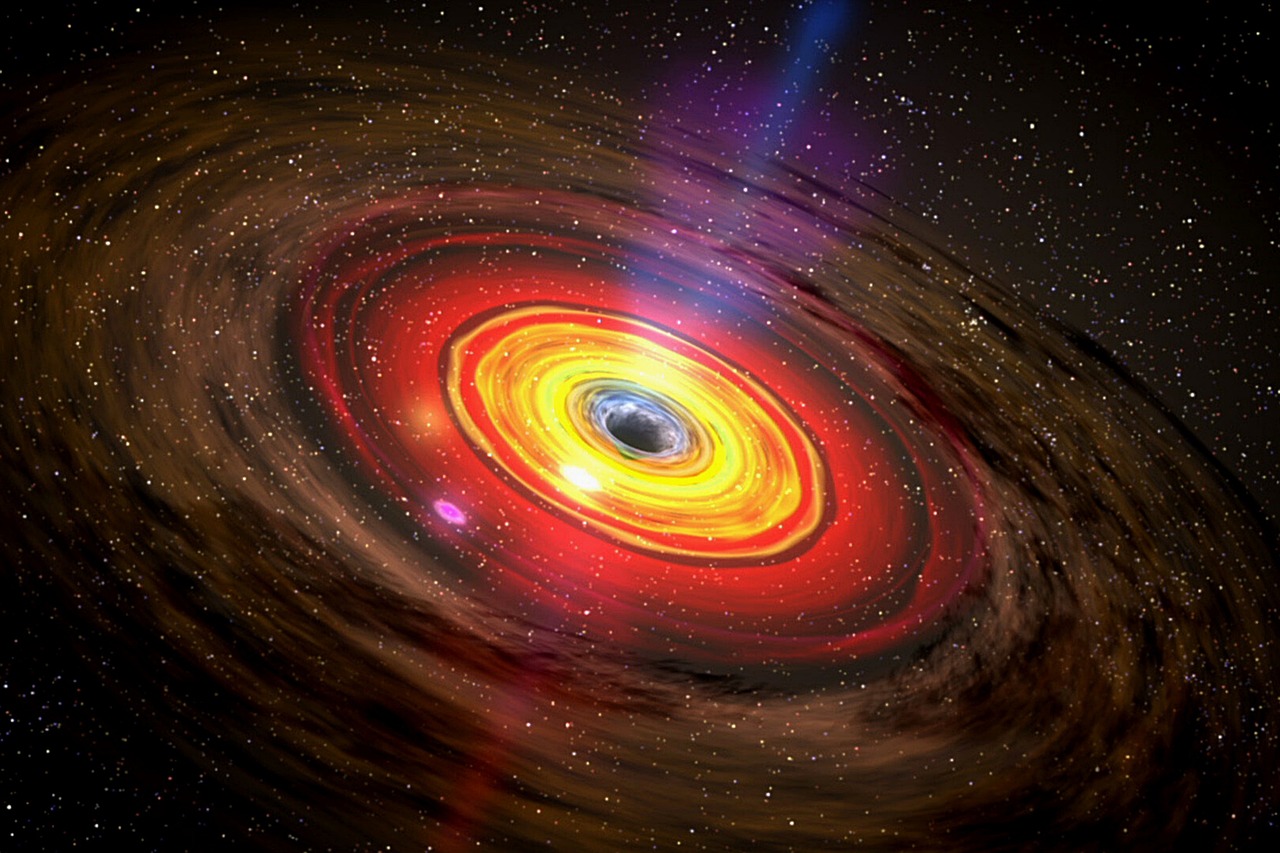
Black holes can sound like science fiction until you look at the data behind them. They affect star motion, bend light, launch jets, heat gas, and create gravitational waves when they merge. They also give researchers a way to test gravity under conditions that cannot be made in a lab. If there is one part of astrophysics that feels strange but still measurable, black holes fit that place well.
Gravitational Waves Turn Collisions Into Signals
LIGO, Virgo, and KAGRA have made black hole mergers part of regular astronomy. Caltech’s LIGO Lab announced that the network recorded its 200th gravitational-wave candidate of the O4 observing run on March 19, 2025. The same announcement noted that the earlier O1, O2, and O3 observing runs recorded 90 detections between September 18, 2015, and March 25, 2020. That rise shows how detector upgrades and longer observing runs have changed the amount of usable data. (ligo.caltech.edu)
Event Horizons Test Gravity at the Edge
Black holes are useful to physics because they push measurements to the limit. Near an event horizon, gravity controls what happens. Measurements of black hole masses, spins, surrounding disks, and jets help test how matter behaves when energy density is very high. For a reader, the practical point is simple: not every black hole story is about “swallowing” things. Many are about motion, heat, magnetism, and the shape of space-time.
Neutron Stars Add Dense Matter Clues
Neutron stars often come into the same discussion because they are dense, fast, and active. When neutron stars merge, they can produce gravitational waves and light signals, so scientists can study the same event in more than one way. These events may also help explain where heavy elements come from. Gold in a wedding ring has a space-related history, which is still a strange thought when you are standing in a jewelry store.
Are Exoplanets Bringing You Closer to Life Beyond Earth?
Exoplanet research is one of the parts of space science that many people follow closely. It connects with a question almost everyone has asked at some point: are there other living worlds? The direct answer is still unknown. The search, however, is now much more specific. Scientists compare planet size, star type, orbit, density, temperature range, and possible atmospheric gases.
Confirmed Worlds Show Planet Systems Vary
The confirmed exoplanet count matters because it shows how different planet systems can be. Hot Jupiters orbit close to stars. Super-Earths sit between Earth and Neptune in size. Some planets circle two stars. Others orbit small red dwarfs, which are common but active. NASA’s 2026 count of more than 6,200 confirmed exoplanets gives researchers a broad sample, although the data still has detection bias because large close-in planets are easier to find. (science.nasa.gov)
Atmospheres Are the Next Big Filter
A planet’s atmosphere can tell researchers more than its orbit alone. Transit spectroscopy studies starlight passing through a planet’s air, where molecules leave small marks in the data. Water vapor, carbon dioxide, methane, and oxygen-related chemistry can all matter. Context matters as much as the gas itself. A gas that looks interesting in one setting may be normal in another. Good work in this area takes time, even when headlines move faster.
Habitability Needs More Than Water
Water helps, but it is not a final proof of habitability. A planet also needs the right pressure, radiation level, geologic activity, stable climate, and enough time. A planet in the habitable zone might still be hit hard by stellar flares. Another planet might hold water but have no useful atmosphere. If a claim sounds too simple, it has probably left out the difficult parts. See also: AI.
Can Dark Matter and Dark Energy Be Solved Soon?
Dark matter and dark energy are two reasons modern cosmology is still not settled. They are not small fixes in the model. They shape the large-scale universe in current thinking, but their real nature is still unknown. This is a place where better data helps, but patience is needed. Improved maps may cut down the list of possible answers, though a full answer could still take years.
Galaxy Motion Points to Hidden Mass
Dark matter is inferred from gravity. Galaxy rotation, cluster behavior, and gravitational lensing suggest that more mass exists than visible stars and gas can explain. No one can hold a jar of dark matter in a lab, at least not now. Its gravitational effects still show up again and again in separate observations, which is why it remains central to astrophysics.
Cosmic Expansion Points to Dark Energy
Dark energy is tied to the accelerated expansion of the universe. It is harder to picture than dark matter because it is not just “missing stuff.” In current models, it acts more like a property linked to space and expansion. Surveys such as Euclid are built to improve measurements of galaxy clustering and weak gravitational lensing, giving researchers a better way to compare possible explanations.
Better Surveys May Narrow the Options
The next step is not one dramatic photograph. It is a matter of stronger statistics. Large surveys collect millions or billions of measured objects, and researchers compare those patterns with cosmological models. From the outside, this work can look dry. Still, this is where large claims either hold up or fail. If the map becomes better, the theory has to match it.
How Should You Read Big Space Discoveries Without Getting Misled?
Space news can be exciting, but it can also be overstated. A phrase like “may change everything” often means the result is interesting but still needs more data. You can enjoy the story and keep an eye on the evidence at the same time. That habit is useful for any reader following fast-moving science.
Check the Instrument and Method
First, ask what detected the signal. A transit light curve, a spectrum, an image, and a gravitational-wave strain pattern are different kinds of evidence. Each one has strong points and weak points. If an article explains the method in plain terms, that is usually a good sign. If it only says scientists are “stunned,” it is worth slowing down.
Separate Candidates From Confirmed Findings
Many space results start as candidates. Exoplanets may need repeated transits or radial-velocity checks. Gravitational-wave alerts may need full catalog analysis. Early galaxy distances may need spectroscopy. A candidate is not a fake result; it is a claim still going through checks. That small word matters more than many headlines suggest.
Look for Independent Follow-Up
Strong results usually attract follow-up. Other teams check the data, test the model, or observe the same target again with another instrument. If a finding survives that process, confidence grows. If it fades, the process still worked. Science sometimes says no without much noise.
FAQ
Q1: What Is Astrophysics Space Science? A: It is the study of physical processes in space, including stars, galaxies, black holes, planets, cosmic expansion, and high-energy events. It uses data from telescopes, spacecraft, detectors, and computer models.
Q2: Why Is the James Webb Space Telescope So Important? A: Webb observes mainly in infrared light, which helps scientists study early galaxies, star formation, planet atmospheres, and dusty regions that visible-light telescopes may miss.
Q3: Have Scientists Found Life on Another Planet? A: No confirmed evidence of life beyond Earth has been publicly verified. Researchers have found many exoplanets and some atmospheric clues, but life claims need much stronger proof.
Q4: What Are Gravitational Waves? A: They are ripples in space-time produced by extreme events, such as merging black holes or neutron stars. LIGO, Virgo, and KAGRA detect them with highly sensitive instruments.
Q5: Will Dark Matter Be Solved Soon? A: It is possible, but not guaranteed. New surveys and experiments are improving the evidence, yet the exact nature of dark matter remains one of the hardest open problems in physics.