


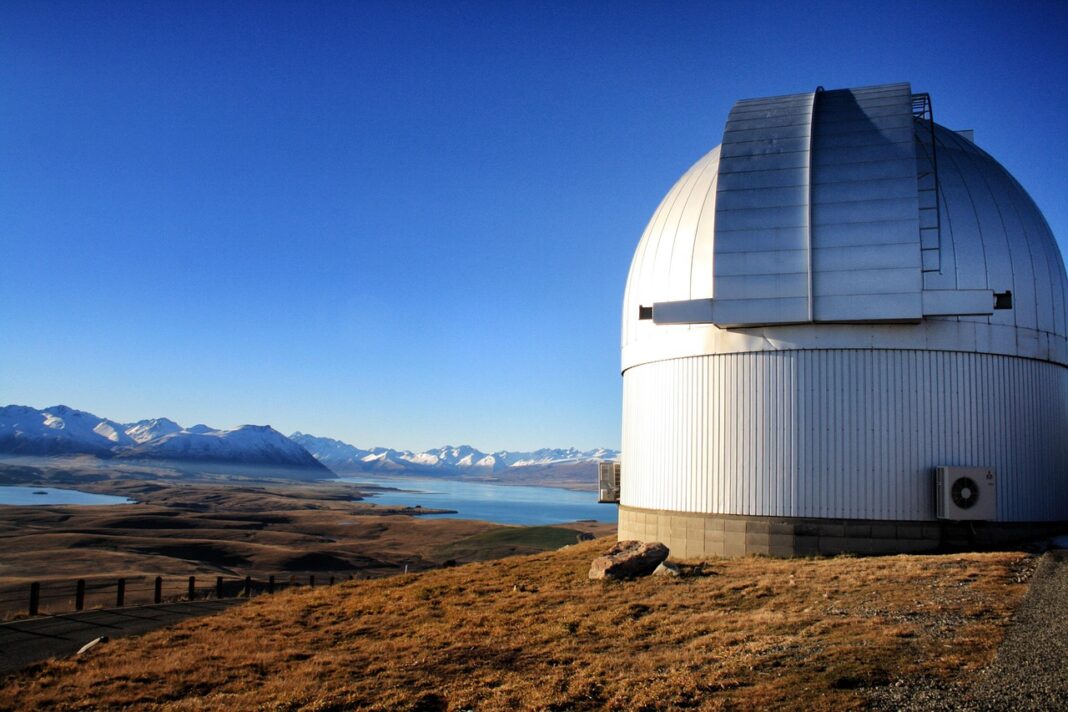

Why the Roman launch matters now
Space and science news in 2026 is increasingly about scale. Discovery is moving beyond occasional headline images toward large, repeatable surveys that make the sky searchable across time, wavelength and target class. NASA’s Nancy Grace Roman Space Telescope launched on August 30, 2026, on a SpaceX Falcon Heavy from Kennedy Space Center, beginning a roughly three-month journey toward the Sun-Earth L2 region. Roman will not replace Webb, Euclid or smaller missions. It adds a wide-field infrared observatory built to find patterns across huge areas of the universe, from dark energy and dark matter to exoplanets and transient events. For readers tracking the wider market for space science data, the story is not one telescope alone, but a connected observation infrastructure coming online. See more coverage in the Space Science section. (nasa.gov)
Roman matters because it changes the scale of the questions astronomers can ask. Webb is optimized for extraordinary sensitivity and targeted observations. Euclid is building a vast map of the dark universe. SPHEREx is scanning the entire sky spectrally. Roman sits between these roles: it can survey large regions while still producing sharp infrared data. NASA says the mission will investigate dark matter, dark energy and exoplanets, while also supporting many additional studies that may not be fully defined until researchers begin working with the data. (science.nasa.gov)
A timeline of recent space science milestones
The current space science cycle is best read as a sequence of overlapping milestones, not as isolated announcements. Several missions now feed into the same big questions: how the universe evolved, how planets form, how life’s ingredients move through space, and how solar activity affects technology near Earth.
| Date | Milestone | Why it matters |
|---|---|---|
| October 15, 2024 | NASA, NOAA and the Solar Cycle Prediction Panel announced that the Sun had reached the solar maximum period of Solar Cycle 25. | It raised the importance of missions that monitor solar wind, energetic particles and space-weather risks. |
| January 29, 2025 | NASA reported that asteroid Bennu samples contained molecules key to life on Earth and evidence of saltwater history. | The finding strengthened sample-return science as a tool for studying early solar system chemistry. |
| March 11, 2025 | SPHEREx and PUNCH launched together. | The paired launch linked infrared all-sky mapping with solar-wind imaging. |
| March 19, 2025 | ESA released Euclid’s first survey data, including 26 million galaxy detections in one week of observations. | It showed how survey telescopes can turn galaxy populations into statistical evidence. |
| February 2, 2026 | NASA’s IMAP began its primary science mission. | Some IMAP data now supports near-real-time space-weather observations headed toward Earth. |
| April 15, 2026 | NASA highlighted SPHEREx maps of icy regions in the Milky Way. | The mission is helping trace water ice and other molecules across star-forming environments. |
| July 15, 2026 | Webb scientists reported a hidden planet in the Beta Pictoris system. | The discovery showed how spectroscopy can reveal planets even when they are difficult to see as bright points. |
| August 11, 2026 | NASA completed the Lunar Environment Monitoring Station hardware for future Artemis deployment. | The Moon is being prepared as a long-term science site, not only a destination for visits. |
| August 30, 2026 | Roman launched from Florida. | The new observatory begins a survey mission expected to widen the data available for cosmology and exoplanet research. |
The pattern is clear: survey missions, sample laboratories, solar monitors and lunar instruments are converging. Much of today’s space and science news is now about systems of observation rather than single spacecraft.
From iconic images to survey astronomy
The modern space-telescope story used to be dominated by spectacular individual images. Those still matter, especially for public understanding and detailed target studies. But the center of gravity is shifting toward catalogs, repeated scans and cross-mission comparisons. ESA said Euclid’s March 2025 data release covered 63 square degrees of sky, equivalent to more than 300 times the full Moon’s apparent area, and included 26 million galaxies, more than 380,000 classified galaxies and 500 strong gravitational lens candidates. ESA also said Euclid’s first cosmology data release was planned for October 2026. (esa.int)
Roman adds a different survey profile. NASA describes Roman as a wide-view infrared telescope at L2 that will make its data public once processed. Its large surveys are designed to support work by many teams at the same time. That matters because one observation can hold evidence relevant to galaxy evolution, gravitational lensing, supernovae, black holes, small solar system bodies and exoplanet microlensing. (science.nasa.gov)
NASA’s launch-day updates also point to the operational data challenge. Roman’s Wide Field Instrument is a 300-megapixel infrared camera with 18 detectors, and NASA has said the observatory is expected to downlink about 1.4 terabytes of data per day during operations. At that level, the mission is as much a data-management project as an optical engineering project. (nasa.gov)
How Roman, Webb, Euclid and SPHEREx complement each other
Roman’s role becomes clearer when it is placed beside other active observatories. Webb can examine selected targets in exceptional detail. Euclid is designed to map large-scale cosmic structure. SPHEREx is building all-sky infrared spectral maps. Roman brings a combination of wide field, infrared sensitivity and repeated survey strategy that can identify targets for follow-up and provide statistical context for discoveries made elsewhere.
| Mission | Primary strength | What readers should watch |
|---|---|---|
| James Webb Space Telescope | Deep, targeted infrared observations | Atmospheres, early galaxies, planet formation and detailed follow-up of unusual objects |
| Euclid | Large cosmic maps for dark matter and dark energy studies | Galaxy shapes, gravitational lensing and cosmology data releases |
| SPHEREx | All-sky infrared spectroscopy | Water ice, organic molecules, galaxy mapping and the cosmic background |
| Roman | Wide-field infrared surveys with high-resolution data | Dark energy tests, exoplanet statistics, transient events and open survey archives |
SPHEREx is a useful example of this new operating model. NASA reported in April 2026 that SPHEREx can measure ices and molecules in and around molecular clouds and is the first infrared mission specifically designed to find such molecules over the entire sky through a large-scale spectral survey. By late 2025, according to NASA, SPHEREx had completed the first of four planned all-sky infrared maps. (nasa.gov)
Webb continues to supply the high-detail discoveries that surveys can place in context. In July 2026, NASA reported that Webb observations revealed Beta Pictoris d, a giant exoplanet in a well-studied nearby system. The notable point was not only that another planet was found. It was identified through the chemical fingerprint of its atmosphere, showing how spectroscopy can expose worlds that are otherwise hard to separate from surrounding light and dust. (science.nasa.gov)
The solar system is becoming a laboratory
Not every major development is about distant galaxies. Space science is also becoming more laboratory-like within the solar system, where samples and instruments can be studied under tighter constraints. The OSIRIS-REx Bennu samples are a clear example. NASA reported in January 2025 that in-depth analyses found amino acids, all five nucleobases used by life on Earth to store and transmit genetic instructions, and evidence of a saltwater-rich history. NASA emphasized that the findings are not evidence of life, but they do suggest that conditions and ingredients relevant to life were widespread in the early solar system. (nasa.gov)
Follow-up Bennu work has continued to add detail. NASA reported in 2026 that scientists found bio-essential sugars including ribose and glucose in the returned samples, along with unusual organic material and presolar grains. The broader lesson is that sample-return missions can preserve delicate materials that meteorites may lose or alter during atmospheric entry and Earth exposure. (nasa.gov)
The Moon is also re-entering the science agenda. NASA said on August 11, 2026, that engineers had completed hardware development and testing for the Lunar Environment Monitoring Station, or LEMS. The suitcase-size instrument suite is designed for continuous, long-term monitoring of moonquakes and meteorite impacts near the lunar south polar region. It is not yet a deployed instrument; NASA said it will remain in a Goddard clean room until assigned to an Artemis mission. (science.nasa.gov)
Space weather is again a front-page science issue
Space-weather monitoring is another reason the current news cycle matters. NOAA’s Space Weather Prediction Center said NASA, NOAA and the Solar Cycle Prediction Panel announced on October 15, 2024, that the Sun had reached the solar maximum period of Solar Cycle 25. Solar maximum is not a single day when activity stops afterward. It is a broad active phase associated with more sunspots, flares and coronal mass ejections. (spaceweather.gov) See also: AI.
That context explains why heliophysics missions have practical importance. IMAP began its primary science mission in February 2026, and NASA said some IMAP data is now feeding into a near-real-time system for observations of solar wind and energetic particles headed toward Earth. Such data can support forecasters who warn spacecraft operators, aviation users and other affected sectors about possible adverse space-weather effects. (science.nasa.gov)
PUNCH adds another piece by observing the Sun’s outer atmosphere and the solar wind together. The mission’s goal is to help scientists understand how coronal structures become solar wind and how eruptions evolve as they move through the inner solar system. This is where space science overlaps with infrastructure resilience: satellites, navigation, communications and power-grid planning all benefit from better warning time and stronger physical models.
What to watch next
The next phase will test whether these missions deliver on their survey promises. For Roman, the immediate milestones are commissioning, deployments, instrument activation and first science images expected after the post-launch checkout period. NASA said before launch that the first images were expected by early 2027, after deployments, calibrations and tests. (science.nasa.gov)
For Euclid, the key watch item is its first major cosmology data release, planned by ESA for October 2026 as of the March 2025 release note. For SPHEREx, the question is how the remaining all-sky maps improve chemical and cosmological measurements. For Webb, the strongest stories may come from follow-up observations of targets found or contextualized by survey missions. For lunar science, LEMS will matter most once it is assigned to and deployed by an Artemis crew.
The takeaway is that 2026 is not simply a year of new hardware. It is a year in which space science is becoming more networked, more data-heavy and more open to cross-checking between missions. Future space and science news should therefore become richer and more complex: headline discoveries will still arrive, but the evidence behind them will increasingly come from linked archives, repeated measurements and comparative analysis.
Frequently asked questions
Why is Roman different from Webb?
Webb is optimized for deep, targeted observations of selected objects. Roman is designed for wide-field infrared surveys, allowing astronomers to study large populations of galaxies, stars and planetary systems and then identify targets that other observatories can examine in more detail.
Does the Bennu sample prove life exists beyond Earth?
No. NASA has been clear that Bennu’s molecules and saltwater history are not evidence of life. They show that ingredients and environments relevant to life existed in early solar system materials, which helps scientists study how prebiotic chemistry may have been distributed.
Why does solar maximum still matter in 2026?
Solar maximum is a phase, not an instant. Even after the peak is identified, elevated activity can continue to affect satellites, radio communication, navigation systems and aurora forecasts. That is why missions such as IMAP and PUNCH remain relevant.
When will Roman start producing science results?
Roman must complete its journey to the L2 region and pass commissioning steps before routine science begins. NASA has said first science images are expected after that process, with early 2027 identified as the initial public-image target before broader survey results accumulate.
What is the main trend in space and science news now?
The main trend is the rise of survey-driven discovery. Missions are collecting large, public datasets that can be compared across wavelengths, timescales and scientific disciplines, making astronomy less dependent on single observations and more dependent on connected evidence.